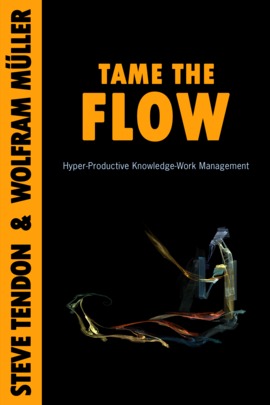
Description: This book is about how to manage knowledge-work, and in particular about how to bring a knowledge organization to a state of hyper-productivity. Hyper-productive teams and organizations have always existed, both in the business and military fields. Naturally, they are rare statistical outliers. The main focus of this book is how one can build and manage a hyper-productive knowledge-work organization, by taking as a source of inspiration the experience matured in the field of software engineering. Software development organizations — like Microsoft, Google, Oracle; but also high profile open source organizations like Apache, Ubuntu, Drupal and others — can be considered as archetypal knowledgebased organizations, because the totality of artifacts produced by a software business is purely immaterial. Software development organizations were the first one to confront the challenges of completely immaterial processes, entirely based on knowledge. They were also the first organizations to experience the socio-technological impact of information technology (especially the development of computer networks) on their internal work processes and organizational structures. Due to its frantic and exponential pace of innovation, the field of software development also became a testbed for a variety of approaches and methods for managing immaterial knowledge work, typically under the form of software development processes and methodologies. Numerous alternatives evolved over a relatively short period, with a lot of healthy competition in between them; with vehement “holy wars” between proponents of one approach or another; and with many anecdotes about both successes and failures. Valuable insights can be gained by studying the organizational and managerial approaches successfully adopted by the industry that produced the information revolution — that is, those organizations that engage first hand in software development — and then by extrapolating those organizational and managerial processes to the more general case of knowledgebased organizations. Nowadays, the majority of organizations have become knowledge-based. Even the most resilient and traditional "brick and mortar" businesses are forced to become knowledgebased organizations. For instance, consider the impact of largescale 3D printing on the construction industry ("Contour Crafting"), where bricks and mortar literally become software. Or nanoscale technologies, where manufacturing at the sub-atomic level becomes software. The key tenet of this book is that organizational hyper-productivity stems from the two Noble Patterns of "Unity of Purpose" and "Community of Trust." The leaders and the top executives of the organization play a critical role in creating the conditions for these patterns to become effective. Management must play an active role in leading the organization towards these conditions. In the case of software (and knowledge) organizations, management will have to gain a deep understanding of the nature of software or knowledge work; and that nature is rooted in empiricism. Top executives already have that understanding; though they might not be aware of it, and – unfortunately – do not act consequently. Management must create the conditions for the development of a learning organization. Financial responsibility must be exercised differently, and in way that is compatible with the empirical nature of knowledge work. Key roles must be nurtured, while each team needs to develop their own shared vision of their purpose. Practical help comes from many sources, and we will look specifically, into like: Kanban, Scrum and the Theory of Constraints. The Theory of Constraints nurtures Unity of Purpose and Community of Trust in many ways. In particular, the Theory of Constraints squarely addresses the need to arrive at common metrics by which all and everybody are driven; and overcomes the structural impediments (rooted in the use of cost accounting and efficiency metrics for management purposes) which are the sources of divergence of purpose and hidden agendas. Kanban and Scrum are widely used in modern knowledge work businesses. The Theory of Constraint can extend them in powerful ways, bringing more predictability of behavior of the system as a whole, as well as of the individuals. Their combination becomes a powerful breeding ground for the development of Unity of Purpose and Community of Trust. Both Kanban and Scrum can be extended with features of the Theory of Constraint, and help creating a hyper-productive organization. The book will present practical ways by which such combination might be realized. We have made it easy for you to find a PDF Ebooks without any digging. And by having access to our ebooks online or by storing it on your computer, you have convenient answers. To get started finding Tame The Flow: Hyper-Productive Knowledge-Work Management, you are right to find our website which has a comprehensive collection of manuals listed. Our library is the biggest of these that have literally hundreds of thousands of different products represented.
Show morePage
488
Format
ebook
Published
N/A
Publisher
Leanpub
Language
eng
Original Title
N/A
Readers also enjoyed
See all
Shoe Dog: A Memoir by the Creator of Nike

The Prepper’s Survival Bible: Your Complete Guide to Surviving Any Crises & Disasters. Bug-In & Bug-Out, Food & Water Prep, Off-Grid Living, Homesteading, Urban Survival, Bushcraft & More!

AP World History: Modern Premium, 2026: Prep Book With 5 Practice Tests + Comprehensive Review + Online Practice (Barron's AP Prep)

The Stylish Life: Golf

Birds of Missouri Field Guide (Bird Identification Guides)

Fifty Places to Sail Before You Die: Sailing Experts Share the World's Greatest Destinations

The Power and the Glory: The History of the World Cup

Lonely Planet The Mediterranean